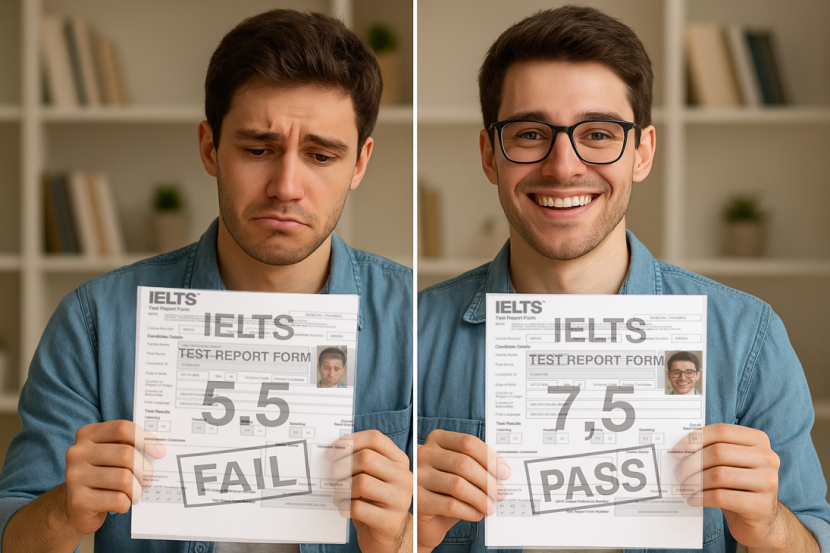
Overcoming IELTS Failure Anxiety: How to Beat Stress and Boost Your Score ⏰ 16 minute read
Overcoming IELTS Failure Anxiety: Tips, Strategies, and Real Stories
1. Introduction
If you’re reading this, chances are the word IELTS makes your heart beat a little faster. You’re not alone. For millions of students, professionals, and dreamers across the world, the IELTS exam feels like a golden key — the one thing standing between them and their future.
Maybe you want to study at a top university abroad. Maybe your family is counting on you to secure permanent residency in Canada, Australia, or the UK. Or maybe your job requires you to prove your English skills. Whatever your reason, one thought probably keeps circling in your mind:
👉 “What if I fail?”
This fear is so common that it has a name: IELTS failure anxiety. And the scary part? The fear itself often causes more damage than the exam. I’ve seen brilliant English speakers freeze up in the speaking test, forget simple words, and walk out convinced they had failed. I’ve heard students say, “I can write essays in class, but the moment I sit for IELTS, my brain goes blank.”
Sounds familiar? If yes, don’t worry. In this article, we’ll go deep into:
Why IELTS creates so much pressure
The psychology behind failure anxiety
Common reasons people fear the exam
Real stories of candidates who struggled but later succeeded
Practical tips and strategies to break free from this fear
By the end, you’ll see IELTS not as a monster but as just another exam — one you can beat with the right mindset and preparation.
2. What is IELTS Failure Anxiety?
Failure anxiety is the fear of not succeeding in something important. In exams, it shows up as nervousness, stress, or self-doubt before and during the test.
But IELTS anxiety is often stronger than regular exam stress. Why? Because IELTS isn’t just about passing a class. It’s tied directly to life-changing goals.
Think about it:
A university student in India may need Band 7.0 to study in the UK.
A nurse in the Philippines may need Band 7.5 for licensing in Australia.
A family applying for Canadian PR may see IELTS as their last obstacle.
That’s a lot of weight on one exam.
Failure anxiety often looks like this:
You’ve prepared well, but the night before the test you can’t sleep.
You enter the speaking room and suddenly your mind goes blank.
You’re in the listening test, but your brain keeps repeating: “What if I fail?” instead of focusing.
Example:
Normal question: “Do you prefer reading books or watching movies?”
Instead of answering normally, under stress you panic:
“What if my grammar is wrong?”
“What if I don’t use big vocabulary?”
“What if the examiner thinks I’m not fluent?”
And suddenly your performance drops.
3. Why Do People Fear Failing IELTS?
3.1 Financial Pressure
The test costs $200–$300 (or more). Retaking it feels like burning money.
👉 Example: A friend from Nepal failed four times. Each retake felt like “collecting failure slips” and the money stress made her even more anxious.
3.2 Academic Insecurity
Some doubt their ability or struggle with grammar, vocabulary, or accents.
👉 Example: A Vietnamese candidate panicked at fast British/Australian accents in Listening.
3.3 Family & Social Expectations
Parents, relatives, and friends constantly ask about results. The shame feels heavier than the test.
👉 Example: A Pakistani student feared family dinners more than results.
3.4 Immigration & Career Pressure
Professionals often need IELTS for jobs and visas.
👉 Example: A Filipino nurse said: “It’s not just my dream — my family is waiting for me to pass.”
3.5 Past Failures
Once you’ve failed before, your brain keeps reminding you.
👉 Example: One candidate failed six times. On her seventh try, she said: “I know my English is fine, but I carry my past results into the exam hall.”
4. The Psychology of IELTS Failure Anxiety
Stress hormones (like cortisol) kick in:
Faster heartbeat
Poor memory recall
Lower concentration
That’s why people blank out.
Cycle of anxiety:
Fear of failing → anxiety
Anxiety → poor performance
Poor performance → failure
Failure → more fear next time
5. Real Stories of IELTS Struggles & Success
Story 1: The Student Who Almost Gave Up
Ravi from India failed three times (6.0, then 6.5). On his fourth try, after proper coaching, he got 7.5.
👉 “Failure wasn’t permanent — anxiety made it look bigger than it was.”
Story 2: The Nurse With Family Pressure
Maria from the Philippines needed 7.5. She failed speaking repeatedly due to nerves. After daily practice and recordings, she passed on her 5th try and now works in Sydney.
Story 3: The Persistent Candidate
Ahmed from Pakistan failed IELTS six times, stuck at 6.5 in writing. With targeted feedback, he finally achieved Band 7.
👉 “Failure isn’t final. The real failure is not learning from it.”
6. Strategies to Overcome IELTS Failure Anxiety
6.1 Mindset Shifts
Failure = feedback
You only need to succeed once
6.2 Smart Preparation Techniques
Take a diagnostic test
Focus on weak areas
Practice under exam conditions
Get feedback
6.3 Stress Management
Deep breathing (inhale 4s, hold 4s, exhale 6s)
Visualization
Positive self-talk
6.4 Building Confidence
Speak English daily
Watch/listen in English
Write short journals
Summarize articles
6.5 Practical Test-Taking Tips
Know your target band
Choose correct test version
Familiarize with test center
Arrive early
7. What to Do After an IELTS Failure
Don’t panic
Analyze your TRF
Focus on weak spots
Plan retake with time
Consider alternatives (TOEFL, PTE, CELPIP, etc.)
8. Motivational Insights
Edison failed 1,000+ times.
Rowling was rejected 12 times.
IELTS failure is temporary — your dream is permanent.
9. Expert & Coaching Advice
Anxiety often comes from lack of strategy, not weak English.
Essays must follow IELTS style.
Answers must be expanded.
Coaching or study groups help.
10. Conclusion
Fear is normal — but it doesn’t control you.
You only need to succeed once.
👉 Next time you ask, “What if I fail?”
Answer: “What if I succeed?”

Article by Michael Lang
Published 25 Aug 2025