Understanding Your English Assessment Results - 5 to 10 min read ⏰
Understanding Your English Assessment Results
First things first – why does this test matter?
If you’ve landed here, it probably means you’ve taken my free grammar assessment — or you’re curious about it.
This isn’t an IELTS exam. It’s a quick check of your grammar level, built from 40 simple questions that cover the kind of mistakes I’ve seen students make again and again over the years. Think of it as a temperature check. Nothing scary, but definitely useful.
The goal? To help you figure out where you stand before diving into IELTS training.
What your score actually tells you
It’s tempting to treat your result as a final verdict — but it isn’t. This test just looks at core grammar: tenses, sentence structure, punctuation, and a few tricky bits that often trip people up.
Your result is a guide, not a grade. It tells you how ready you are to move into IELTS work, and whether you need to brush up on your grammar first. That’s it.
If you scored low — don’t panic. Honestly, I’ve seen students jump from the lowest band to full IELTS readiness in just a few months of focused practice. On the other hand, if you scored high, it’s a green light to move ahead — but there’s always something to polish.
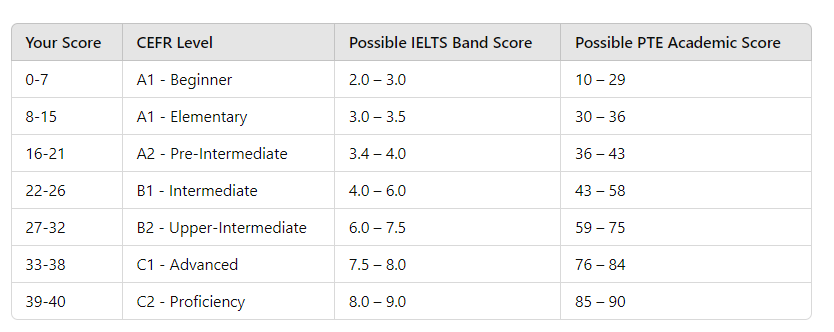
Band Scores – What each range means
Let’s break this down into plain English. Here’s what each score range roughly means.
🔴 Beginner (0–7):
Still at the starting gate. You might know a few English words or phrases, but grammar is shaky. I’d say: pause on IELTS for now and build a solid base first. No shame in that — everyone starts somewhere.
🟠 Elementary (8–15):
You’ve got some of the basics, but still making frequent errors. You’ll benefit most from general English lessons right now. Keep going — you’re on the path.
🟡 Pre-Intermediate (16–21):
You’re beginning to get comfortable with grammar rules. Not quite IELTS-ready, but close. Mix grammar study with light IELTS practice to build momentum.
🟢 Intermediate (22–26):
Good progress. You can express ideas clearly in writing and speech, even if the grammar isn’t always perfect. Time to start structured IELTS lessons.
🔵 Upper-Intermediate (27–32):
Well done. You’re using complex structures and making fewer mistakes. IELTS Band 6.5 or above is within reach — with the right practice.
🟣 Advanced (33–38):
Strong grammar control, strong foundation. You should be working with high-level IELTS material now and aiming for Band 7+.
🟤 Proficient (39–40):
Top of the class. You’ve likely studied English for years, and your grammar reflects that. IELTS Band 8–9 is a realistic target — especially with focused Writing and Speaking work.
So... what now?
This result doesn’t mean much unless you use it.
Here’s what you can do right away:
- 📌 Join my Telegram channel — there’s a free Reading and Listening lesson pinned at the top
- 📄 Revisit any weak areas in grammar (I’ve got lessons for that too)
- 🗣️ Book a 30-minute speaking session with me — I’ll listen and build you a custom plan
- 🧠 Want to just explore? Browse the free quizzes and tips section
You don’t need to spend money until you’re ready. But when you are — I’ll be here to help.
Quick Note from Me
This blog — like all the content on my site — is written by me, Michael Lang. I’ve been teaching IELTS and English for over 16 years. I don’t outsource it. I don’t paste in AI scripts. Sometimes I use tools for spellchecking, but the stories, advice, and tone? That’s mine.
And if you ever want to challenge me on anything I’ve written — even better. I love hearing from students.
Email me at [email protected] any time.

Article by Michael Lang
Published 24 May 2024